

The Legend Of Zelda Skyward Sword Review
Ever since The Air current Waker and Twilight Princess re-released on the Wii U with cleaner Hard disk drive graphics, fans of Nintendo's 35-year-old run a risk were looking forward to seeing Skyward Sword receive the aforementioned treatment. Information technology was, after all, the concluding '480p' entry they had left to be ported, but the Wii original was and so unique that its modern adaptation had to go beyond the visual upgrade in several regards. Now that The Legend of Zelda: Skyward Sword Hard disk drive is finally launching on the Nintendo Switch a decade afterwards its initial release, I'm happy to report that there's more to this remaster than meets the eye.
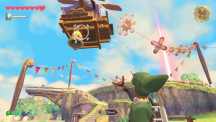
But beginning things beginning, the graphics. I did my homework -and I'grand sure many of you reading this also have washed the same- and played some parts of the Wii game to ready myself for this review. And I accept to say that, while no Wii game aged particularly well in terms of visuals, Skyward Sword was definitely i of the worst cases. It wasn't but a matter of its sub-HD resolution causing jaggies galore, merely also the sacrifices the dev team had to make in club to continue the game running. Chopped world aside, the draw altitude was reduced considerably, while a water-coloured bokeh effect struggled to conceal the low-res elements. Moreover, when the game was outputted to an Hard disk screen by means of a digital interface, its film noise and artefacts became painfully notorious.
This is an ad:
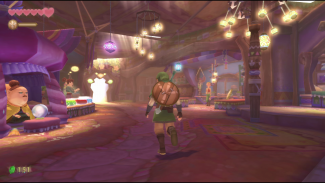
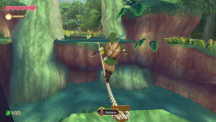
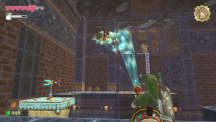
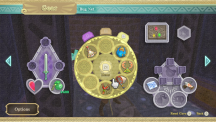
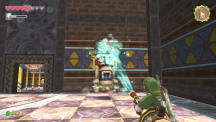
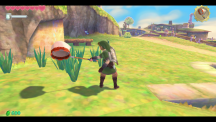
Now all that is gone. The fivefold HD resolution (1080p on Boob tube, 720p on handheld) paints a much crisper motion picture on screen, with both scenery and characters featuring soft and defined edges (not to mention map and menus no longer looking like a blurry mess). At the same fourth dimension, the significantly increased image quality allows for more vivid colours, which goes well with the slightly more contrasted lighting used for this version. Furthermore, the depth of field has been increased, and while the water-coloured bokeh remains there as an artistic staple, it now kicks in much farther abroad, allowing the states to enjoy the vistas and to detect elements of interest in the altitude.
This makes what was a cute artistic work finally come to life as it was meant to await originally. Granted, you can spot its low-poly nature, or how some textures hither and there didn't upscale properly, but it's a very decent restoration try that takes a archetype and even renders it playable for many. And if yous add together the duplicated framerate (now running at shine sixty fps) to the mix, the issue not only is pleasing to the eye, but besides to a motility-based gameplay experience where going with the flow is fundamental.
Considering how Nintendo was going to handle controls was, apart from the graphical upgrade, the main and most controversial point of this remaster. The Wii game was the epitome of its generation's motion controls, a full, deep, 'serious' if you volition, adventure, designed around the belated, but highly anticipated one:1 tracking provided by the Wii MotionPlus applied science. At the aforementioned fourth dimension, it is true that many fans were totally uninterested in that command method, and so much so, they wouldn't touch this game with a Deku stick unless Nintendo implemented traditional controls. And here we got both.
This is an advertizement:
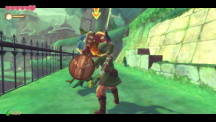
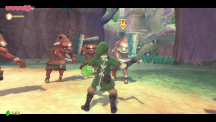
The motion actions with the Joy-Con controllers feel slightly better at present. The tech has seemingly evolved ever since, but perhaps it'southward the aforementioned threescore fps framerate that makes the deviation. Swinging your sword, rolling and scoring a handbasket with your bombs, or manoeuvring your beetle and your loyal Loftwing seem more responsive and less laggy, even if the difference is quite minimal, as I've been able to compare. You still demand to re-calibrate the centre every now and so (equally happened with Super Mario Galaxy's gyro-based pointer recently), and I run into synchronisation problems with what looks similar a faulty Joy-Con, on the welcome screen menu. But other than that, information technology feels as neat as it is a truly unique game with multiple puzzles and combat based on what you lot physically do with your hands, an feel that we won't see repeating itself unless we go fully VR. Oh, and a pro tip: you better use the Joy-Con strap addition for much better grip and ergonomics, even if the shape itself won't come close to the Wii remote's.
And, are those push-based controls any good? Well, I would personally recommend everyone give the motility controls a try, every bit a practiced part of the whole significant, enjoyment, and purpose of this game will soar away without them. That existence said, the solution proposed for the traditional controls is proficient enough, with the right stick imitating your sword swings in every direction. Information technology takes a while to become used to, equally you don't printing a push to attack, but it's fast and accurate, perhaps "too much" when you compare information technology to your performance controller in hand, if you know what I mean.
Now, there'southward a couple of caveats to go along in mind here: if you play motion on TV and so -plainly- buttons on handheld, the transition isn't really seamless as there are some changes in the layout to rethink earlier feeling like dwelling. In other words, making the panel-defining switch gesture isn't as natural equally with most of the hybrid system's catalogue.
This is an advertising:
The second thing to proceed in heed is much, much more important, as nosotros're talking about a game changer here. Seeing how conveniently placed the right stick is when you opt for motion controls, Nintendo has mapped to Joy Con R's stick what probably is the most welcomed new addition to this remaster: the power to motion your camera freely. Remember information technology wasn't possible on the Wii equally you had to go on locking it like in the quondam N64 days? This enhances the game significantly, making exploration experience nicer and more cinematic, while besides aiding you with motion aiming in kickoff person. One time you realise, you won't stop adjusting your view. With the new button controls yous must printing 50 every bit you tilt the stick, and there's an alternative motion-based camera (heh, the irony) that merely isn't half every bit practiced.
Other piddling tweaks and touches we appreciate are every bit subtle as printing the names of the speaking characters on screen, having both controllers rumble depending on the activeness, fast-forwarding dialogues, or seeing how the game saves as shortly as y'all walk by a bird statue which, believe me, too makes the experience flow better.
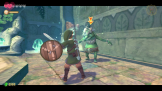
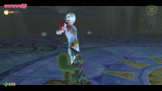
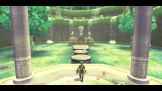
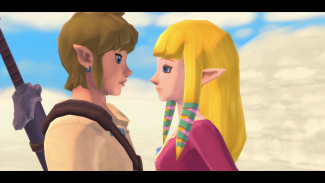
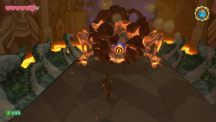
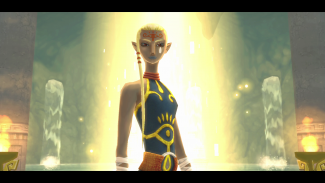
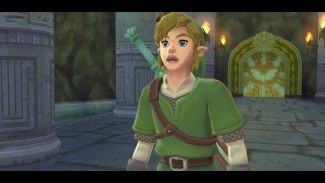
The balance is history. The game itself didn't age as well as it was the last of its kind, a tired former 3D Zelda formula that was sealed for adept after the eruption of Breath of the Wild. It'due south a heavily interrupted experience that takes some time to get going (despite a few added shortcuts) merely to then face other pacing and linearity issues, along with some decisions as annoying equally Demise'south appearances. However, information technology besides tells a beautiful story, which is more than character-based than usual (Impa nosotros love you), it includes some brilliantly smart boss and dungeon designs (Lanayru, nosotros're looking at you), and it brings back an arroyo to the adventure genre that is rarely seen nowadays. It'due south l+ hours of inventive puzzle-solving and rewarding gainsay, and wielding the sword feels as exciting as ever.
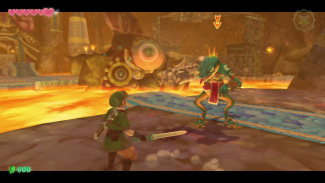
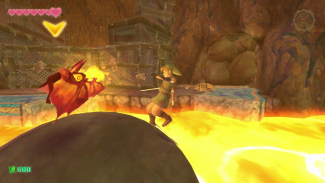

The Legend Of Zelda Skyward Sword Review,
Source: https://www.gamereactor.eu/the-legend-of-zelda-skyward-sword-hd-review/
Posted by: colemanhanch1990.blogspot.com
0 Response to "The Legend Of Zelda Skyward Sword Review"
Post a Comment