

Yu Gi Oh Card Back
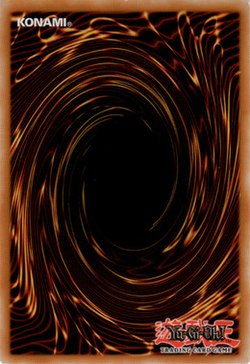 Back of the Yu-Gi-Oh! Trading Menu Game card | |
| Publishers | Nihon: Konami (1999−present) US: Upper Deck (2002−08) Konami (2008−present) |
|---|---|
| Publication | 1999 (1999) |
| Players | i vs. 1 [ane] |
| Age range | 12 and upwardly (OCG) 6 and up (TCG) |
The Yu-Gi-Oh! Trading Card Game [a] is a collectible card game adult and published past Konami. Information technology is based on the fictional game of Duel Monsters created by manga artist Kazuki Takahashi, which appears in portions of the manga franchise Yu-Gi-Oh! and is the fundamental plot device throughout its various anime adaptations and spinoff series.[2]
The trading card game was launched by Konami in 1999 in Japan and March 2002 in Northward America.[3] It was named the top selling trading menu game in the world past Guinness World Records on July 7, 2009, having sold over 22 billion cards worldwide.[4] As of March 31, 2011, Konami Digital Amusement Co., Ltd. Nippon sold 25.2 billion cards globally since 1999.[5] As of January 2021[update], the game is estimated to have sold nearly 35 billion cards worldwide and grossed over ¥1 trillion [six] [7] ($nine.64 billion).[8] Yu-Gi-Oh! Speed Duel, a faster and simplified version of the game, was launched worldwide in January 2019. Another faster-paced variation, Yu-Gi-Oh! Rush Duel, launched in Japan in April 2020.
Gameplay [edit]
In the trading carte du jour game, players draw cards from their respective decks and accept turns playing cards onto "the field". Each histrion uses a deck containing forty to lx cards, and an optional "Extra Deck" of up to fifteen cards. At that place is also an optional fifteen bill of fare side deck, which allows players to swap cards from their main deck and/or extra deck betwixt games. Players are restricted to three of each carte du jour per deck and must follow the Forbidden/Limited menu list, which restricts selected cards by Konami to be limited to ii, one, or null. Each actor starts with 8,000 "Life Points", with the main aim of the game to use monster attacks and spells to reduce the opponent'due south Life Points. The game ends upon reaching ane of the following conditions:[9]
- A player loses if their Life Points reaches zero. If both players attain zero Life Points at the aforementioned time, the game ends in a draw.
- A role player loses if they are required to describe a carte, merely has no more cards to draw in the Primary Deck.
- Certain cards have special conditions which trigger an automatic win or loss when its conditions are met (e.g. having all 5 cards of Exodia the Forbidden 1 in the mitt or all five letters of the Destiny Lath on the field).
- A player can forfeit at any time.
Zones [edit]
Cards are laid out in the following mode:
- Main Deck: The player's Primary Deck is placed here confront-down, and can consist of 40 to threescore cards. Normal, Effect, Ritual, and Pendulum Monsters can be stored hither. Spell and Trap Cards are likewise stored hither.
- Actress Deck: The player's Extra Deck is placed here confront-down, if they accept one, and may accept 15 cards consisting of Fusion, Synchro, Xyz, and Link Monster cards. Pendulum Monsters are placed face-up here when they would otherwise be sent from the field to the Graveyard.
- Graveyard (GY): A Zone where cards are sent when they are discarded or destroyed, such as used Spell/Trap Cards which were used or monsters that are tribute or destroyed in battle.
- Principal Monster Zones: A field of v spaces where Monster cards are placed when successfully Summoned. Prior to the addition of Link Monsters, any kind of monster could be placed in that location at any time. Afterward Link Monsters were introduced, monsters from the Extra Deck could only be Special Summoned from the Extra Deck to the Actress Monster Zone, or a Main Monster Zone a Link Monster points to, upward until the rule modify for April 2020 onward, where merely Link Monsters and Pendulum Monsters from the Extra Deck follow this restriction.
- Extra Monster Zones: Introduced with Link Monsters, this is a Zone where monsters from the Extra Deck can be Summoned. An Extra Monster Zone is not a part of either player'south field until they Summon a monster to the Extra Monster Zone.
- Spell/Trap Zones: V spaces in which either Spell or Trap cards can be placed. The leftmost and rightmost Spell/Trap Zones can optionally be treated every bit "Pendulum Zones" by placing Pendulum Monsters there, allowing players to use Pendulum Effects and perform Pendulum Summons.
- Field Zone: A Zone where Field Spell cards are placed.
- Banished Zone: Cards that are "banished" past card effects are placed outside of the game in a pile.
Phases [edit]
Each player's turn contains six phases that take place in the following order:
- Describe Phase: The turn player draws one card from their Deck.[10]
- Standby Phase: No specific action occurs, but information technology exists for menu effects and maintenance costs that activate or resolve during this specific phase.[ten]
- Master Phase 1: The turn actor may Normal Summon or Set up a monster, activate cards and furnishings that they control, alter the battle position of a monster (provided it was not summoned this plough), and Set Spells or Traps face-downwards.[10]
- Battle Phase: The plow role player may choose to assail their opponent using whatever monsters on their field in Attack Position. Depending on the position of opposing monster, the attacking monster'due south ATK points are taken into business relationship against the opposing monster'southward ATK or DEF points. If both monsters are in Attack Position, the monster with fewer ATK points is destroyed and its owner takes life betoken harm equal the divergence between both monster'south ATK points (if both monsters take equal ATK points, they are both destroyed and no harm is taken, unless both of their ATK points are 0, in which neither is destroyed). If the opposing monster is in Defense Position and has fewer DEF points than the attacking monster'south ATK points, it is destroyed and the possessor takes no damage. Notwithstanding, if its DEF bespeak is higher, the attacker takes life point damage equal to the difference betwixt the ii values. If the defending player has no monsters defending them, a Directly Assault tin can be performed, with the defending thespian receiving life point damage equal to the attacking monster'south ATK points. The plow player can cull to not enter the battle phase and instead go to the End Stage.[ten]
- Master Phase 2: The actor may exercise yet actions that are available during Master Stage 1, though they cannot repeat sure actions already taken in Master Phase 1 (such as Normal Summoning) or change the battle position of a monster that has already been summoned, attacked, or had their battle position changed during the same plow.[10]
- End Phase: This phase as well exists for carte du jour furnishings and maintenance costs that actuate or resolve during this specific phase. Once this phase is resolved, the player ends their turn.[10]
The role player who begins the game does non draw during the Describe Phase and cannot enter the Battle Stage during their offset plough.[10]
Card types [edit]
Gameplay revolves around three types of cards: Monster, Spell, and Trap cards. Monster cards are monsters used to attack and defend against the opposing role player, mainly for the purpose of dissentious an opponent's life points. Spells, which can either be played from the hand or set for later employ, provide various effects such as altering a monster's force, drawing additional cards, or removing an opponent's cards from the field. Traps are cards that are set on the field in advance and activated in subsequently turns when certain conditions are made, such equally when an opponent targets a player's monster.
With some exceptions, a typical Monster cards possesses ATK and DEF points which determine its attack and defense power in battles, a Level represented past stars, with more powerful monsters typically possessing higher levels, an Attribute that certain furnishings may react to, and a description listing the Monster's types and whatever furnishings or summoning weather condition they may possess. Monsters are summoned to the field through 3 primary categories of summoning; Normal, Tribute, and Special. Once during a histrion's Main Phase, players tin choose to Normal Summon a Lv4 or lower Normal or Issue monster from their hand in face-up Set on Position or face-downward Defense Position, or Tribute Summon a Lv5 or higher Monster by tributing one or more Monsters already on the field. Special Summons are performed by utilising menu furnishings or fulfilling the atmospheric condition of other summoning methods, such as those used to summon cards from the Extra Deck, and can be performed as many times as possible if the weather condition are met.
The game currently features the following types of Monster.
- Normal (yellow): A monster with no furnishings of its own. Stored in the Main Deck and can be Normal, Tribute, or Special Summoned.
- Effect (orangish): A monster that possesses at least one event. Can be summoned in the same mode as Normal Monsters.
- Ritual (blue): Stored in the Main Deck, these monsters can typically but be Special Summoned by using a Ritual Spell card and tributing required monsters listed in its instructions.
- Fusion (regal): Stored in the Actress Deck, these monsters are summoned by utilising cards with a "Fusion" effect, such equally Polymerization, and tributing monsters listed in the monster'southward description.
- Synchro (white): Stored in the Extra Deck, these monsters are summoned past tributing from the field a Tuner-type monster and ane or more non-Tuner-type monsters whose levels equal the level of the Synchro Monster being summoned.
- XYZ (black): Stored in the Extra Deck, these monsters possess Ranks as opposed to levels, and require two or more than Monsters whose level is the same as the XYZ Monster's Rank. These monsters become the XYZ Monster'southward "overlay material", which can and then exist sent to the GY to actuate effects.
- Pendulum (green gradient): Variations of other monster types which, if sent from the field to the GY, are placed confront in the Extra Deck instead. Pendulum Monsters can be placed in Pendulum Zones in the leftmost and rightmost Spell/Trap Zones, where they can utilize Pendulum Effects. When both Pendulum Zones comprise Pendulum Monsters with differently valued "Pendulum Scales", players tin can perform a Pendulum Summon during the master phase to summon multiple monsters from the paw and face-upward Pendulum Monsters from the Extra Deck whose levels lie between the two Pendulum Scale values.
- Link (dark blue): Stored in the Extra Deck, Link Monsters have Link values instead of levels and can only exist played in Set on position. These are summoned by tributing i or more monsters on the field that meets the summon requirements, with Link Monsters able to be used as multiple tributes depending on its Link value. Link Monsters feature arrows which, when pointed towards other zones on the field, allows boosted Link Monsters to be summoned outside of the Extra Monster Zone. Link Monsters may also possess effects that can be used when some other carte du jour is a linked zone.
- Token (grayness): A low-level monster that can merely be summoned through menu effects. These cards do not exist outside of the field and are removed from play upon leaving. While official Token Monster cards practise exist, players tin utilize other objects such as coins to stand for Token Monsters.
Spell cards, greenish, are magical spells with a variety of effects, such reviving destroyed monsters. They can be played from the paw during a thespian's turn or placed faced downwardly for activation on a later turn. There are six types of Spell Menu:
- Normal: A spell that can just be activated during the player's Main Phase.
- Quick Play: A spell that can be played at any time during the role player's turn, or tin exist set and activated during an opponent'southward turn.
- Continuous: A spell with a continuous upshot that remains until conditions are met or it is destroyed.
- Equip: A spell that is equipped to a Monster, providing information technology with back up effects. Information technology is removed if the monsters leaves the field or is set confront-down, or the card is destroyed.
- Field: A spell that is placed in a player'south Field Spell Zone, which affects the entire field. Each player can only have one Field Spell in play at a fourth dimension.
- Ritual: A spell that is required to summon a Ritual Monster.
Trap cards, night pinkish, accept to be Fix on a role player'south field face-downwards and can only exist activated subsequently the turn they were ready has passed, including the opponent'due south plough. (Quick Play spells, when Set, have the same rule.) They are generally used to terminate or counter the opponent'southward moves, and come in three varieties.
- Normal: A standard trap that is discarded once its effect resolves.
- Continuous: A trap that remains on the field until destroyed or its conditions are met.
- Counter: A trap that is activated in response to the activation of other cards.[10]
Formats [edit]
Tournaments are frequently hosted either by players or by card shops. In addition, Konami, Upper Deck (at present no longer part of Yu-Gi-Oh! 'southward Organized Play), and Shonen Jump take all organized numerous tournament systems in their respective areas. These tournaments attract hundreds of players to compete for prizes such as rare promotional cards.
In that location are two styles of tournament play called "Formats"; each format has its own rules and some restrictions on what cards are immune to be used during events.
The Advanced Format is used in all sanctioned tournaments (with the exception of sure Pegasus League formats). This format follows all the normal rules of the game, merely besides places a consummate ban on certain cards that are deemed too powerful for tournament play. These cards are on a special list called the Forbidden, or Banned List. There are too certain cards that are Express or Semi-Limited to only existence immune 1 or two of those cards in a deck and side deck combined, respectively. This list is updated every iii months (January 1, Apr ane) and is followed in all tournaments that use this format.[11]
Traditional format is sometimes used in Pegasus League play and is never used in Official Tournaments and reflects the country of the game without banned cards. Cards that are banned in Advanced are express to 1 copy per deck in this format.[12]
The game formerly incorporated worldwide rankings, but since Konami canceled organized play, the ratings were obsolete. Konami has developed a new rating system called "COSSY" (Konami Card Game Official Tournament Support System).[xiii]
With the introduction of the Battle Pack: Epic Dawn, Konami has announced the introduction of drafting tournaments. This continued with a second set for sealed play: Battle Pack: War Of The Giants in 2013. The final Boxing Pack, Battle Pack iii: Monster League, was released in August 2014, with no Boxing Pack products released since.
Product information [edit]
Yu-Gi-Oh! Trading Cards are bachelor in Starter Decks, Structure Decks, booster packs, collectible tins, and occasionally as promotional cards.
Booster packs [edit]
As in all other trading card games, booster packs are the chief artery of card distribution. In Konami's distribution areas, five or nine random cards are constitute in each booster pack depending on the set and each gear up contains around one hundred different cards. However, in Upper Deck'due south areas, early on booster packs independent a random assortment of nine cards (rarity and value varies), with the whole set ranging around one hundred and thirty cards. To catch upwardly with the Japanese meta game, two or more than original sets were combined into one. Now, more recent Upper Deck sets have simply duplicated the original fix. Some booster sets are reprinted/reissued (e.thousand. Nighttime Beginnings Volume i and 2). This type of set usually contains a larger number of cards (around 200 to 250), and they contain twelve cards along with one tip card rather than the normal five or nine. Since the release of Tactical Evolution in 2007, all booster packs that take a Holographic/Ghost Rare card, will also contain a rare. Current sets have 100 dissimilar cards per set. There are also special booster packs that are given to those who attend a tournament. These sets change each fourth dimension there is a different tournament and have fewer cards than a typical booster pack. There are eight Tournament Packs, eight Champion Packs, and 10 Turbo Packs.
Duelist packs [edit]
Duelist packs are similar to booster packs, albeit are focused around the types of cards used by characters in the various anime series. Cards in each pack are reduced from ix to 5.
Promotional cards [edit]
Some cards in the TCG have been released by other means, such as inclusion in video games, movies, and Shonen Bound Mag problems. These cards oftentimes are exclusive and take a special type of rarity or are never-earlier-seen to the public. Occasionally, cards similar Elemental Hero Stratos and Chimeratech Fortress Dragon have been re-released every bit revisions.
Yu-Gi-Oh! Speed Duel [edit]
Yu-Gi-Oh! Speed Duel is a specialised version of the Yu-Gi-Oh! Trading Carte Game which launched worldwide in January 2019. Being based on the ruleset of Yu-Gi-Oh! Duel Links, it features four basic card types: Monster Cards, Spell Cards, Trap Cards and an exclusive type of menu chosen Skill Cards.[14]
Speed Duel games are known for its rapid duels, averaging on 10 minutes.
When compared to the avant-garde format:
- The playing field has only three Monster Zones and three Spell/Trap Zones, as opposed to five.
- Synchro, Xyz, Pendulum and Link Monsters do not exist in Speed Duel.
- There is no Main Phase 2.
- The main deck must have betwixt 20 and thirty cards, as opposed to between twoscore and lx.
- Players begin with 4000 Life Points, as opposed to 8000.
- Players begin the game past drawing 4 cards each, equally opposed to 5.
- Each player can only have ane Skill Carte.
Yu-Gi-Oh! Blitz Duel [edit]
Yu-Gi-Oh! Rush Duel ( 遊戯王ラッシュデュエル , Yū-Gi-Ō Rasshu Dueru ) is a variation of the Yu-Gi-Oh! Trading Card Game which launched in Nippon in Apr 2020 alongside the release of the Yu-Gi-Oh! Sevens anime serial.[fifteen] This variation of the game, which uses a unlike set of cards from the main Trading Card Game, features reworked rules first introduced in Speed Duels.[16]
- The playing field now has just three Monster Zones and three Spell/Trap Zones, and Extra Monster Zones and Pendulum Zones are not featured.
- The stage club for each plow is Describe, Main, Battle, and End. Unlike the main game, at that place is no Standby Phase or Main Phase ii.
- Players brainstorm the game with four cards each, with the starting thespian able to depict on their beginning plough. During the Draw Stage of each player'southward plow, they must keep drawing until they have five cards in their manus. If the player already has five or more than cards in their paw, they may just depict one card. In that location is no maximum limit to the number of cards players can have in their hand. Still, if a player is unable to describe the required amount of cards when asked to (due east.g. if the actor's hand is empty and at that place are four or less cards remaining in their deck at the outset of their Draw Stage), they will automatically lose the game.
- Players can Normal Summon and Tribute Summon as many times every bit possible during a unmarried turn.
- Certain cards, such every bit Blue-Eyes White Dragon, are marked with a "Legend" icon. Each player may only have one Legend bill of fare in their deck.
Comparing to other media [edit]
In its original incarnation in Kazuki Takahashi's Yu-Gi-Oh! manga serial, Duel Monsters, originally known as Magic & Wizards, had a rather bones construction, non featuring many of the restricting rules introduced later on on and often featuring peculiar exceptions to the rulings in the interest of providing a more engrossing story. Showtime with the Boxing City arc of the manga and Yu-Gi-Oh! Duel Monsters anime serial, more structured rules such as tribute requirements were introduced to the story, with the series falling more in line with the rules of the real life card-game by the fourth dimension its spin-off series began. From the Duel Monsters anime onwards, characters utilise cards which resemble their real life counterparts, though some monsters or furnishings differ between that of the existent life trading card game and the manga and anime's Duel Monsters, with some cards created exclusively for those mediums. Yu-Gi-Oh! 5D's featured an anime-original menu blazon known as Night Synchro, which involved using "Dark Tuners" to summon Dark Synchro Monsters with negative levels. Night Synchro cards were featured in the PlayStation Portable video game, Yu-Gi-Oh! 5D's Tag Forcefulness 4, while Dark Synchro Monsters featured in the anime were released as standard Synchro Monsters in the real-life game. Yu-Gi-Oh! Arc-5 features Action Cards, spell and trap cards that are picked upwardly in the series' unique Action Duels, which are not possible to perform in the real life game. In the film Yu-Gi-Oh!: The Dark Side of Dimensions, an exclusive course of summoning known as Dimension Summoning is featured. This method allows players to freely summon a monster past deciding how many ATK or DEF points it has, but they receive impairment equal to that corporeality when the monster is destroyed.[17] The Yu-Gi-Oh! VRAINS anime series features Speed Duels which use a smaller number of Monster and Spell & Trap Zones and remove Principal Phase 2 for faster duels. In the anime, characters can activate unique Skills depending on the situation (for example, the protagonist Yusaku can draw a random monster when his life points are below 1000) once per duel. A similar ruleset is featured in the Duel Terminal arcade machine series and the Duel Links mobile game.
With the exception of the films Pyramid of Light and The Nighttime Side of Dimensions, which base of operations the carte's appearance on the English version of the existent-life card game, all Western releases of the Yu-Gi-Oh! Duel Monsters anime and its subsequent spin-off series, produced by 4Kids Amusement and later Konami Cross Media NY, edit the advent of cards to differentiate them from their real-life counterparts in accordance with U.S. Federal Communications Commission regulations in concerning program-length commercials, likewise every bit to make the show more marketable across non-English speaking countries.[18] These cards are edited to only display their background, illustration, level/rank, and ATK/DEF points.
Konami-Upper Deck lawsuit [edit]
From March 2002[nineteen] to December 2008, Konami'due south trading cards were distributed in territories exterior of Asia past The Upper Deck Company. In December 2008, Konami filed a lawsuit against Upper Deck alleging that information technology had distributed inauthentic Yu-Gi-Oh! TCG cards made without Konami'due south authorization.[20] Upper Deck also sued Konami alleging breach of contract and slander. A few months afterwards, a federal courtroom in Los Angeles issued an injunction preventing Upper Deck from acting equally the authorized benefactor and requiring it to remove the Yu-Gi-Oh! TCG from Upper Deck's website.[21] In Dec 2009, the court decided that Upper Deck was liable for counterfeiting Yu-Gi-Oh! TCG cards, and information technology dismissed Upper Deck's countersuit against Konami.[22] [23] [24] Konami is now the manufacturer and benefactor of the Yu-Gi-Oh! TCG. Information technology runs Regional and National tournaments and continues to release new Yu-Gi-Oh! TCG card products.
Notes [edit]
- ^ Yu-Gi-Oh! Official Card Game ( 遊☆戯☆王オフィシャルカードゲーム , Yū-Gi-Ō Ofisharu Kādo Gēmu ) in Asia.
References [edit]
- ^ "Yu-Gi-Oh! TRADING CARD GAME". yugioh-carte du jour.com. Retrieved August 24, 2014.
- ^ Kaufeld, John; Smith, Jeremy (2006). Trading Card Games For Dummies . For Dummies. John Wiley & Sons. pp. 123–139. ISBN0470044071.
- ^ Miller, John Jackson (2003), Scrye Collectible Menu Game Checklist & Price Guide, Second Edition, pp. 667–671.
- ^ "Yu-Gi-Oh! Card Sales Set New World Record". Konami.jp. August 7, 2009. Archived from the original on August 10, 2009. Retrieved March 5, 2014.
- ^ "Best-selling trading card game". Guinness World Records. March 31, 2011. Archived from the original on Dec 27, 2014. Retrieved March 5, 2014.
- ^ "「ワンピース」でも「鬼滅」でもなく…史上最も稼いだ意外なジャンプ作品". Livedoor News (in Japanese). Livedoor. Jan 29, 2021. Retrieved January thirty, 2021.
- ^ "『鬼滅の刃』は『ジャンプ』史上最も稼いだマンガではない! 売り上げ1兆円作品とは(週刊女性PRIME)". Yahoo! News (in Japanese). Yahoo! Japan. January 29, 2021. p. 2. Retrieved Jan 30, 2021.
- ^ "Historical exchange rates (i,000 JPY to USD)". fxtop.com. January 2021. Retrieved January 30, 2021.
- ^ Yu-Gi-Oh! Trading Carte Game Beginner's Guide. Konami. p. 3.
- ^ a b c d e f g h Yu-Gi-Oh! Trading Card Game Official Rulebook. Konami Digital Entertainment.
- ^ "Official YuGiOH U.South. Site – "Yugioh Forbidden/Limited Cards: Advanced Format – Limited and Forbidden Lists"". Yugioh-card.com. Retrieved February 22, 2012.
- ^ "Official YuGiOH: Traditional Format – Limited Lists". Yugioh-menu.com. Retrieved Feb 22, 2012.
- ^ "YGO TCG News: Konami Unleashes Champion Pack 8 on Duelists Everywhere". Shriektcg.twoday.net. Retrieved February 22, 2012.
- ^ "SPEED DUELING, A NEW Way TO PLAY THE Yu-Gi-Oh! TRADING CARD GAME, NOW Bachelor".
- ^ "遊戯王ラッシュデュエル - 公式サイト".
- ^ "あそび方 - 遊戯王ラッシュデュエル".
- ^ InnovationYGO (January 10, 2017). "Yu-Gi-Oh! The Dark Side Of Dimensions - Sneak Peek Prune - Dimension Summoning". Archived from the original on December 21, 2021 – via YouTube.
- ^ "Kirk Up Your Ears". Anime News Network. July 22, 2010. Retrieved September one, 2016.
- ^ "Upper Deck to Deliver Yu-Gi-Oh! Trading Carte Game to the Usa marketplace". Upper Deck Entertainment. February 11, 2002. Archived from the original on April 2, 2002. Retrieved March 25, 2014.
- ^ "Yu-Gi-Oh! Trading Menu Game". El Segundo, California: Yugioh-card.com. January 13, 2010. Archived from the original on February 27, 2010. Retrieved February 22, 2012.
- ^ "Order Granting Preliminary Injunction Confronting The Upper Deck Company" (PDF). iptrademarkattorney.com. Feb 11, 2009. Retrieved September 1, 2016.
- ^ "courtroom-order-konami-summary-judgment-counterfeit-trademark- copyright" (PDF). iptrademarkattorney.com. December 23, 2009. Retrieved September three, 2016.
- ^ "Konami-court-order-granting-finding-no-dispute-unauthorized-sales" (PDF). iptrademarkattorney.com. December 23, 2009. Retrieved September 3, 2016.
- ^ "Konami-MSJ-court-order-grants-counterclaims" (PDF). iptrademarkattorney.com. December 29, 2009. Retrieved September 3, 2016.
External links [edit]
- Official Konami Trading Bill of fare Game website
- Yu-Gi-Oh! Online worldwide portal
- Yu-Gi-Oh! Decklist-Archive
- Official Yu-Gi-Oh! Card Database
- Guinness Globe Records best selling trading card game as of 31 March 2011

Yu Gi Oh Card Back,
Source: https://en.wikipedia.org/wiki/Yu-Gi-Oh!_Trading_Card_Game
Posted by: colemanhanch1990.blogspot.com
0 Response to "Yu Gi Oh Card Back"
Post a Comment